So most of you know that I get paid to evaluate manuscripts, partial manuscripts, queries and synopses for writers who are struggling to get theirs ready for submission. My job is to point out areas for improvement and teach them how to strengthen the overall plot, even out the pacing, increase the tension, enhance the voice, find the theme, hook the reader and balance the elements of the story in a cohesive manner. I point out what is not working in what they've written (and why) and then show them how to make it work.
But writers must learn to write with a critical eye toward their own work. They must learn to anticipate the questions that agents, editors, crit partners and readers will have about their story. They must learn that for every writing decision they make, there is a consequence. Just what do I mean?
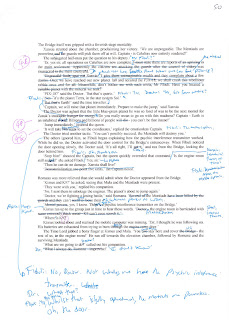
I'm finding more than ever that there are many writers who are capable of penning entire books without the first clue as to what their book is really about. Ask them and they will not be able to answer. Ask what their main character needs to overcome--what motivates the main character and they will be completely stumped.
But I'm not judging. I've been there. It took me two long years to understand that my first novel while it has angels in it, is not about angels. And to allow others to reduce it to "an angel book" would be like allowing people to reduce Cinderella to a book about Princesses.
As a writer you must be able to fully understand what drives and motivates your characters. Otherwise, their actions and reactions will be forced and unrealistic. You must have a realistic portrayal that rings true to the reader. Action-reaction.
For example: Your character is leaving for boarding school. She doesn't want to go but is being forced to as punishment for an incident involving alcohol, the police and a boy. Your book opens with the protagonist talking to her mother about leaving. Yet, they are very calm. No one even mentions the incident. There is little indication that the mother is at all concerned about the daughter's behavior or that the daughter has resentment for being sent away. But maybe the daughter is glad to be getting out of the house and away from her too strict parents. At the very least it is not the opening one would expect given the set up created by the author. There is little tension, casual conversation and the sixteen year old spends time on the phone with a friend. I would have to assume that this teen would be grounded for a long time behind an incident like this and if she were on the phone, she would be sneaking and talking lots of smack about her horrible parents--I know I would.
NOW. Let me backtrack. My guess is that the author of the story I pulled this example from used this as a means to an end. We all do this when we write--I think. We say to ourselves, "I need a way to get my character from point A to point B." Here, the author needed a reason for the protag to be forced to leave her home. This is all well and good. The reason itself it a great one. HOWEVER. You must support the "reason" throughout the story and fully understand how the choice you make as a storyteller now impacts your story and your character.
As for the story--you must now spend some time on what an incident like that does to the teen and her relationship with her family. You need to address whether this was a one-time thing or if she is a troubled teen. You should consider how a teen may be feeling about her parents who are punishing her by sending her away. And what of the drugs? Hers? The boy's? Were they together? Does she have feelings for him? Has she been ostracised since the incident?
You don't need to address all of those issues in one scene or chapter but throughout the story, over the course of the book--since you brought it up and made it pivotal, the reader has a right to have closure. And by the way, so does your protagonist.
In other words, think about the doors you open in your work. Make sure the hinges are on tight, they (the doors) have a nice coat of paint and close properly. Every plot and sub plot should have a good beginning, middle and end. You can have a catalyst or bridge to get you from one plot point to another but that bridge had better not have any holes in it.
Remember, writing fiction does not consist solely of making things up. Your reader is intelligent and can sense a faulty plot a mile away. Be sure to close loopholes, answer all possible "whys" you anticipate a reader may have and don't leave your story or characters exposed.
I truly hope this has helped. Please visit
my blog for more info on critique and editorial services. Best of luck with your writing.
xoxo-
Georgia
PS--Last day to enter
Halloween in July Scavenger Hunt! Winner will be announced next week! Win signed books and stuff from
Heather Brewer,
Michelle Zink,
Nancy Holder and
Claudia Gray!


 Posts
Posts


